Community ecology and biodiversity
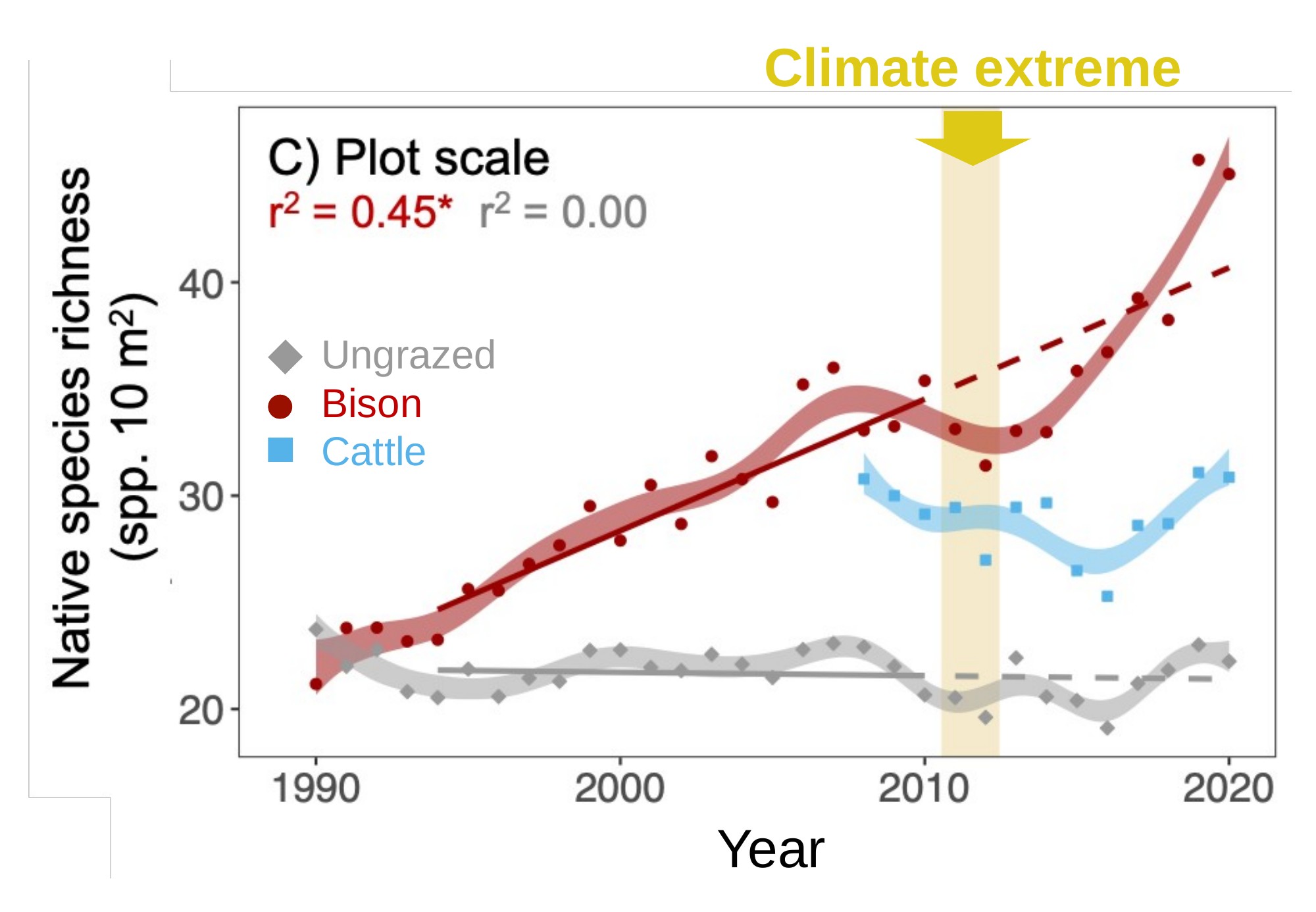
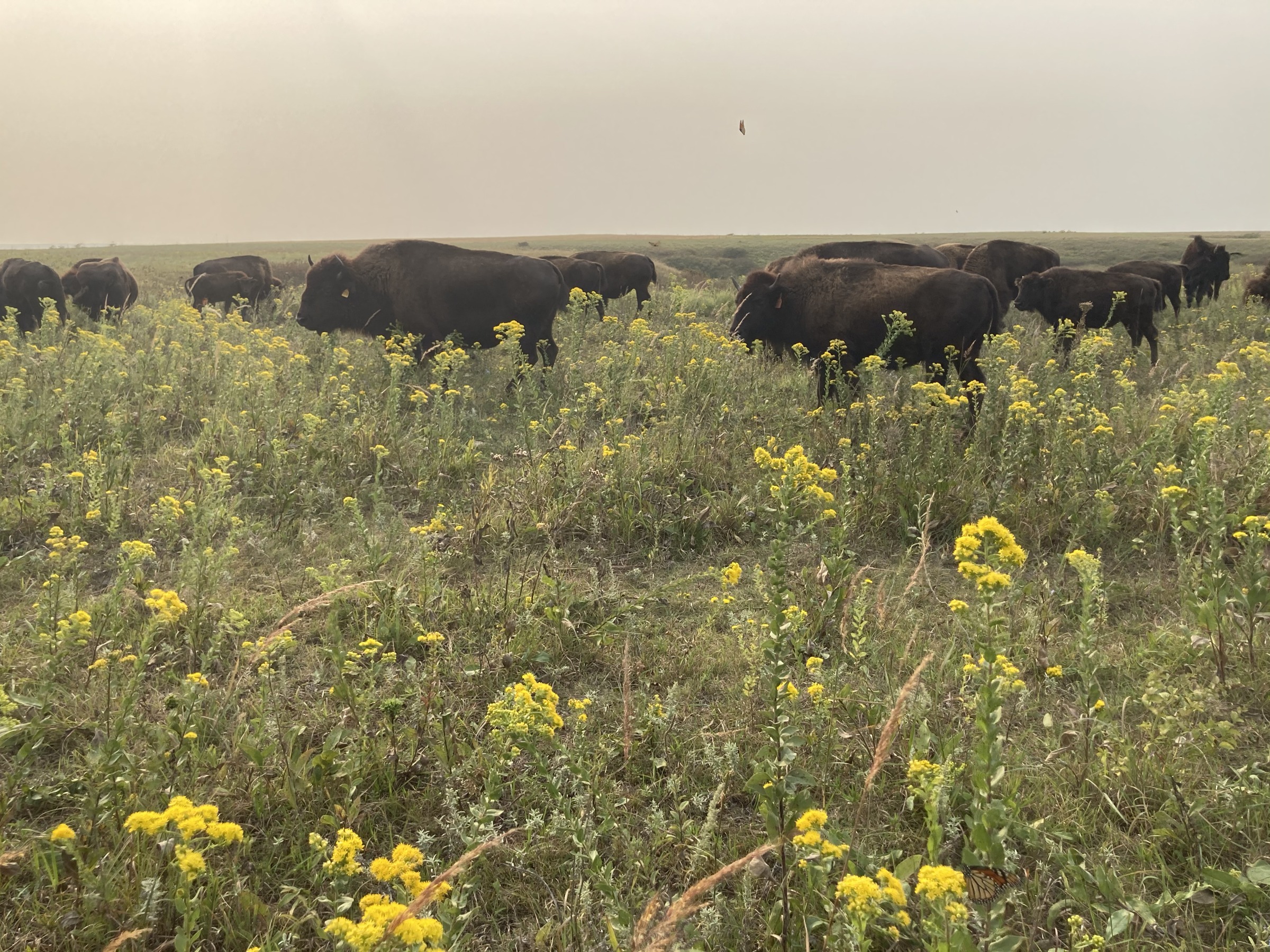
To understand how global change affects grasslands, we draw on community ecology theory, especially the roles of disturbance and dominant species. Bison, for instance, can act as keystone consumers: by grazing dominant grasses they can give plants with different resource needs more opportunity to coexist, and by removing fuel they can also change how often and how intensely a patch burns. Our primary focus is on plants, but graduate students and collaborators have led related work on pollinators, birds, and small mammals.
Recurring themes
- Shifts in dominant species can reshape communities. As strong competitors such as tall grasses or woody plants become more abundant, grassland plant diversity often declines sharply.
- Habitat heterogeneity created by grazers and localized disturbances.
- Following a change in disturbance, grassland communities can take years to decades to reach a new state—we refer to this as long transients.
Representative papers
- Bison, plant diversity, and drought resilience: Ratajczak et al. (2022) (bison reintroduction in tallgrass prairie) and Bookout et al. (2025) (drought in grazed and ungrazed grasslands).
- Woody encroachment and biodiversity: Ratajczak et al. (2012) (plants), Hope et al. (2026) (small mammals), and Silber et al. (2024) (grassland birds).
- Grazing and encroachment: Noble, Ratajczak & Noble (2025) (bison and eastern redcedar); Noble & Ratajczak (2026), Natural Areas Journal (bison and cattle in mixed-grass prairie).
- Simulation models: Ratajczak et al. (2017) (coexistence of grasses and savanna trees).
- Grazing and pollinator communities: Greenlee’s MS thesis.
Images from this research
Changes every 10 seconds